Custom Search
|



| Dermpath-India Pathology of Angiokeratoma
|
 |
|
Angiokeratoma is a vascular lesion
characterized by dilatation of superficial dermal vessels together with
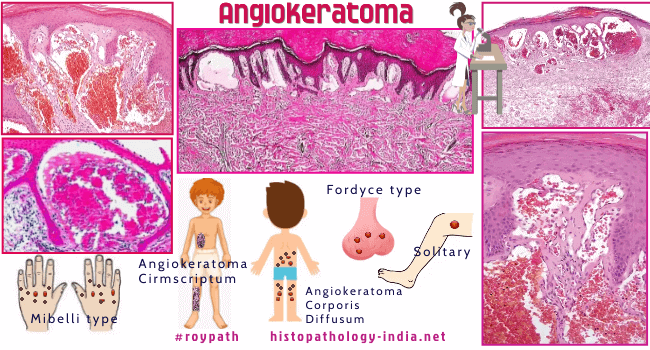
epidermal changes. Clinical variants: 1. Mibelli type: The "Mibelli-type" occurs on the acral sites, mainly digits, of young people affected by repeated attacks of chilblain, which result in a deleterious effects on vessel walls. Girls between 10 and 15 years predominantly affected. 2. Fordyce type: Predilection for adults and elderly patients The "Fordyce-type" occurs on the scrotal skin as a secondary effect to an increased blood pressure in scrotal veins. An equivalent form affecting adult females and occurring analogously on the skin of the vulva has been recorded. Bleeding, pain, pruritus, or burning sensations occasionally present. 3. Solitary and multiple types: The "solitary and multiple papular types" of young individuals affect the lower extremities and is considered a consequence of a congenital deficiency of elastic tissue in regional veins. 4. Angiokeratoma circumscriptum: This is a nevoid hamartomatous lesion arising early in life during infancy or childhood, sometimes in association with other congenital malformation of other sites. Lesions are almost always unilateral, and they occur predominantly on the leg, trunk, or arm. 5. Angiokeratoma corporis diffusum: It is a clinical variant of angiokeratoma that is typically associated with an enzyme deficiency in the metabolism of glycoprotein, most notably Fabry disease, resulting in many other systemic manifestations. Usually before puberty, between the ages of 5 and 10 years.Predilection for "bathing trunk area", including the lower back, buttocks, penis, scrotum, and inner thighs.
Verrucous hemangioma- Dilated vessels are present in the deeper levels
|
|
|
|
|