

Custom Search
|



|
Dermpath-India Pathology of Elastofibroma Dr Sampurna Roy MD 2022
|

|
Elastofibroma is a benign slowly progressive reactive lesion involving
abnormal elastogenesis.
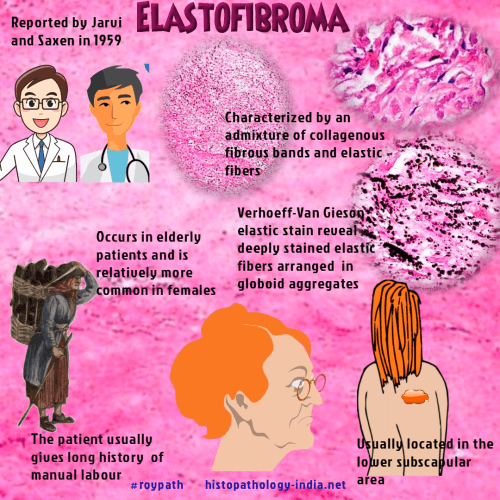
It was first reported by Jarvi and Saxen in 1959 and published in 1961.Jarvi
O, Saxen E. Elastofibroma dorse. Acta Pathol
Microbiol Scand Suppl. 1961;51:83–4.
Bilateral involvement is present in about 10% of all cases.
The patient usually gives long history
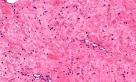
of manual labour. Cases have also been reported in the deltoid muscle, hip, thigh and stomach. Histologically, the lesion is characterized by an admixture of collagenous fibrous bands and elastic fibers.
Elastic stains (like
Verhoeff-Van
Gieson) reveal branched or unbranched fibres with irregular serrated margins or
fibers arranged in
globoid aggregates.
The collagen
deposited in this disease is a mixture of Type I, II and III.
|
|
|


Copyright © 2002-2022 histopathology-india.net