Papillary eccrine adenoma, a
rare benign adnexal tumour, was first described in 1977.
Papillary eccrine adenoma.
Arch Dermatol. 1977;113(5):596-8.
Clinical presentation:
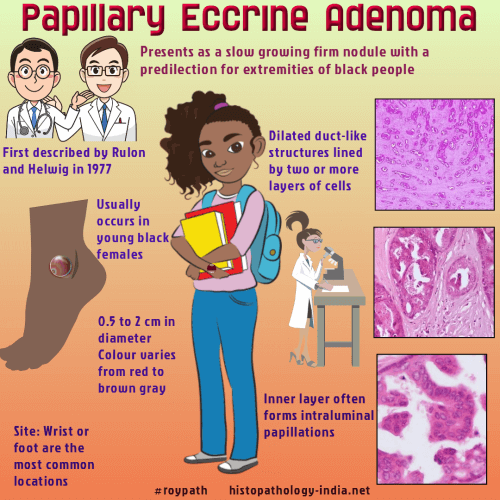
Firm
or hard nodules, frequently of many years' duration, and a large
proportion are situated on the extremities of black persons.
Microscopic features:
Symmetrical lesion
;
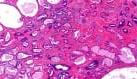
Tumour is composed of
dilated duct-like structures of various sizes with intraluminal papillary projections
;
Ducts are
lined by two or more layers of cells ; Inner layer often forms one or
multiple papillae of variable complexity ;
Lumina contains eosinophilic amorphous
material ;
Fibrous stroma around the lesion is well separated from the surrounding
dermis ;
Stroma
consists of patches of loosely arranged spindled cells and areas of
hyalinized collagen.
Other features -
focal squamous differentiation ; clear cell change ; connection of ducts
to the epidermis ; prominent nerves within the stroma.
Tubulopapillary
hidradenoma' is a term proposed to describe lesions with both eccrine and apocrine
differentiation. It
encompasses a spectrum of lesions that includes
tubular apocrine adenoma and papillary eccrine
adenoma.
Immunohistochemistry:
Demonstrated
immunoreactivity to S-100 protein, carcinoembryonic antigen, and
epithelial membrane antigen. Differential diagnosis:
The differential diagnosis includes other cutaneous neoplasms with
intraductal papillary proliferation. |