Gastrointestinal Stromal Tumour


http://www.histopathology-india.net/Infection.htm

                           HISTOPATHOLOGY INDIA.COM 

                            Adult Respiratory Distress Syndrome

     Dr  Sampurna Roy  MD

 
Web www.histopathology-india.net

June 2007
Acrodermatitis chronica atrophicans

Actinomycosis

Adenovirus

African Histoplasmosis  

AIDS:  Cutaneous lesion associated with AIDS

AIDS related malignant tumours

African Trypanosomiasis

Alphaviruses causing Encephalitis

Amebic Meningoencephalitis

American Trypanosomiasis

Amoebiasis (Entamoeba histolytica)

Ancylostomiasis

Angiostrongyliasis

Anisakiasis

Anthrax Infection

Arenavirus

Argentine hemorrhagic fever

Arthropod-borne viral encephalitis

Ascariasis

Aspergillosis

Atypical Mycobacterial Infection

Babesiosis

Bacillary angiomatosis

Balantidiasis

Bartonellosis

Bejel

Blackwater Fever

Blastomycosis

Blastomycosis-like pyoderma

Bolivian Hemorrhagic Fever

Botulism

Bowenoid Papulosis

Bronchopneumonia

Brucellosis

Buruli Ulcer

Candidosis(Candidiasis)

Chagas' Disease

Chikungunya

Coccidioidomycosis

Cryptococcosis

Cryptosporidium

Cutaneous Infections and Infestations

   1 : Bacterial, Rickettsial and Chlamydial Infections

   2 : Spirochetal Infections

   3 : Mycoses and algal Infections

   4 : Protozoal Infections

   5 : Helminth Infections

   6 : Viral Infections

Cytomegalovirus infection

Dengue

Dermatophytosis

Dematiaceous fungal infection

Diphtheria

Diphyllobothriasis

Dirofilariasis

Dracunculiasis

Echovirus Infection

Enterobiasis

Epidemic Typhus

Epstein-Barr Virus infection

Epstein-Barr Virus Related Malignant Tumours

Erythema chronicum migrans

Escherichia coli Infection

Fascioliasis & Fasciolopsiasis

Fifth Disease

Filariasis

Filovirus

Flavivirus

Giardiasis

Human Papilloma Virus Associated Epidermal Lesions

Infective Endocarditis

Leishmaniasis 

Loiasis

Lupus Vulgaris

Lyme Disease

Lymphocytic choriomeningitis

Lymphogranuloma Venereum

Malaria

Meningococcal Infection

Measles

Molluscum Contagiosum

Mycobacterium Avium Intracellulare

Necrotizing Enteritis (pig-bel)

Negri bodies

Nematode (Roundworm)

Neurosyphilis

Nocardiosis

Norwalk Virus related Diarrhea

Omsk hemorrhagic fever

Onchocerciasis

Pneumocystis Pneumonia

Protothecosis

Pseudomembranous Colitis

Psittacosis

Pulmonary Infection

Rat Bite Fever

Rhinosporidiosis

Rocky Mountain Spotted Fever

Rotavirus diarrhea

Rubella

Schistosomiasis

Shigellosis


 CLICK ON THE IMAGE

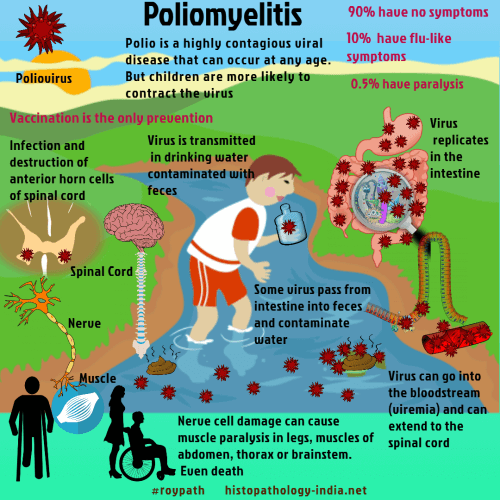
Poliomyelitis is an acute infection by polioviruses. 

 Visit:  Picornavirus Infection  ;  Coxsackievirus Infection ; Echovirus Infection.

  Image1 ; Image2 ; Image3 ; Image4 

Most infections are asymptomatic, but when the virus invades the central nervous system it destroys lower motor neurons, causing paralysis.

Sporadic infections may be seen at any time, but outbreaks occur mostly in summer.

More recent epidemics have stricken adults as well as children.

Polio was sporadic in earlier centuries, but later became epidemic and subsequently pandemic.

The incidence  peaked during the 1950s in many developed countries.

Immunization have stopped its spread in the Western world, but polio remains a major public health problem in many developing countries.

Poliovirus is transmitted in drinking water contaminated with faeces.

The virus replicates in the mucosa of the small intestine.

Some virions pass from there into the faeces, contaminating water and completing the cycle.

Others enter the bloodstream (viremia) and extend to the spinal cord, where they infect and destroy the anterior horn cells, causing paralysis.   Image Link


Abstracts:

Vaccine-associated paralytic poliomyelitis caused by contact infection.Intern Med. 2006;45(6):373-5. Epub 2006 Apr 17.

We encountered an adult patient with acute anterior poliomyelitis (AAP), whose monoparesis developed 28 days after his son's immunization with oral poliovirus vaccine (OPV). Neurological and electrophysiological examinations suggested that his muscular wasting of the left lower limb was due to a lower motor neuron disorder, and magnetic resonance imaging revealed the responsible lesion in the left anterior horn at the thoracolumbar junction. His stool was found to include poliovirus type 3, mainly originating from Sabin 3 by neutrization antibody and PCR-restriction fragment length polymorphism method. This indicated that the AAP resulted from contact with his son. This patient raises the question about OPV in polio-free countries.
 

Vaccine-associated paralytic poliomyelitis caused by contact infection.Intern Med. 2006;45(6):373-5. Epub 2006 Apr 17

We encountered an adult patient with acute anterior poliomyelitis (AAP), whose monoparesis developed 28 days after his son's immunization with oral poliovirus vaccine (OPV). Neurological and electrophysiological examinations suggested that his muscular wasting of the left lower limb was due to a lower motor neuron disorder, and magnetic resonance imaging revealed the responsible lesion in the left anterior horn at the thoracolumbar junction. His stool was found to include poliovirus type 3, mainly originating from Sabin 3 by neutrization antibody and PCR-restriction fragment length polymorphism method. This indicated that the AAP resulted from contact with his son. This patient raises the question about OPV in polio-free countries.

The alpha/beta interferon response controls tissue tropism and pathogenicity of poliovirus.J Virol. 2005 Apr;79(7):4460-9

Poliovirus selectively replicates in neurons in the spinal cord and brainstem, although poliovirus receptor (PVR) expression is observed in both the target and nontarget tissues in humans and transgenic mice expressing human PVR (PVR-transgenic mice). We assessed the role of alpha/beta interferon (IFN) in determining tissue tropism by comparing the pathogenesis of the virulent Mahoney strain in PVR-transgenic mice and PVR-transgenic mice deficient in the alpha/beta IFN receptor gene (PVR-transgenic/Ifnar knockout mice). PVR-transgenic/Ifnar knockout mice showed increased susceptibility to poliovirus. After intravenous inoculation, severe lesions positive for the poliovirus antigen were detected in the liver, spleen, and pancreas in addition to the central nervous system. These results suggest that the alpha/beta IFN system plays an important role in determining tissue tropism by protecting nontarget tissues that are potentially susceptible to infection. We subsequently examined the expression of IFN and IFN-stimulated genes (ISGs) in the PVR-transgenic mice. In the nontarget tissues, ISGs were expressed even in the noninfected state, and the expression level increased soon after poliovirus infection. On the contrary, in the target tissues, ISG expression was low in the noninfected state and sufficient response after poliovirus infection was not observed. The results suggest that the unequal IFN response is one of the important determinants for the differential susceptibility of tissues to poliovirus. We consider that poliovirus replication was observed in the nontarget tissues of PVR-transgenic/Ifnar knockout mice because the IFN response was null in all tissues.

Post-polio syndrome. A case report.Neurol Neurochir Pol. 2004 Jul-Aug;38(4):335-9

Certain acute anterior poliomyelitis survivors express complaints of abnormal fatigue, weakness and muscular atrophy many years after acute onset. These are basic clinical symptoms of so-called post-polio syndrome (PPS). PPS is characterized by a relatively slow, but progressive pathological muscular process, in some cases leading to functional impairment of daily living and professional activity. Breathing, speaking and swallowing impairment are common but not severe medical problems of post-polio patients. Diagnosis is usually based on a typical medical history, electromyographic investigation and exclusion of other diseases presenting similar features. We report a case of PPS in a 49-year-old woman diagnosed in the Neurological Department in Zabrze. Thirty six years after acute anterior poliomyelitis with partial recovery, new symptoms of fatigue, muscular atrophy, exertional dyspnea, walking impairment and joint pain developed. Electromyography revealed features of coexisting spinal denervation and reinnervation in tested muscles. The differential diagnosis excluded other neuromuscular diseases. The patient fulfilled clinical and electromyographic criteria of PPS.

Reduction in thigh muscle cross-sectional area and strength in a 4-year follow-up in late polio.Arch Phys Med Rehabil. 1996 Oct;77(10):1044-8

OBJECTIVE: To study changes in cross-sectional thigh muscle area and muscle strength in late polio subjects over a 4-year period. DESIGN: Longitudinal study of a cohort of polio survivors, comparing subjects who acknowledge (unstable) with those who do not acknowledge (stable) new muscle weakness. SETTING: University hospital. SUBJECTS: Eighteen subjects (6 men, 12 women) with polio-myelitis sequelae (39 to 46 years of age) were studied on two occasions 4 years apart; the first examination was 37 to 44 years after onset of polio. Subjects were recruited through hospital registers, newspaper advertisement, and a patient organization. OUTCOME MEASUREMENTS: Thigh muscle and intermuscular and intramuscular adipose tissue (AT) cross-sectional areas were measured by computed tomography. Isometric muscle strength for knee extension and flexion was measured using a Kin-Com dynamometer. RESULTS: Cross-sectional muscle area decreased on average 1.3 +/- 3.6 cm2 (1.4%, p < .05); the intermuscular and intramuscular AT area increased 1.8 +/- 3.4 cm2 (12.1%, p < .05). When divided by legs in which subjects reported (unstable) or did not report (unstable) or did not report (stable) increased muscle weakness, unstable legs showed significant reduction (p < .05) in muscle area, whereas stable legs did not. Estimated total thigh muscle strength decreased 7.8% +/- 2.9% (p < .01), with a significant (p < .001) reduction in unstable legs (13.4% +/- 4.3%) but not in stable legs. The reduction in strength appears to be greater than the reduction in cross-sectional muscle area, but there is still a significant correlation (r = .44, p < .05). CONCLUSION: The present results demonstrate not only progress of muscle weakness, but also of muscle atrophy in postpolio subjects.

Hemifacial atrophy secondary to poliomyelitis. Int Oral J Maxillofac Surg. 1997 Jun;26(3):215-6.

A 25-year-old woman is presented with hemifacial atrophy due to unilateral bulbar poliomyelitis infection. Although bulbar poliomyelitis is not an uncommon disease, it is rarely a cause of hemifacial asymmetry.

A case of post-poliomyelitis muscular atrophy with cranial nerve signs and widespread muscular atrophy of the extremities.Rinsho Shinkeigaku. 1997 May;37(5):407-9

Here we report a case of a 56-year-old male with post-poliomyelitis muscular atrophy (PPMA), who presented with cranial nerve signs and widespread atrophy of the extremities. He had suffered from poliomyelitis at the age of 2 years. After recovery from the acute stage, the paralysis remained in his left arm. He noticed muscle weakness of the right upper and lower extremities at the age of 45 years and the muscle atrophy progressed to his arms, hip and thigh at the age of 55 years. Neurological examination revealed muscle atrophy of the neck and disturbance of left V, VIII, IX, X and bilateral XI cranial nerves. We diagnosed this case as PPMA from his history and electromyographic and muscle biopsy findings which suggested chronic denervation. Among the 21 PPMA cases in the past in which the acute poliomyelitis had resulted in paralysis of the only one limb, ours was the only case that had muscle atrophy of all the limbs. Cranial nerve involvement is known to occur in acute poliomyelitis; therefore, there is a possibility that the involvement of the cranial nerves in our case might be a delayed progressive symptoms.

Towards an understanding of the poliovirus replication complex: the solution structure of the soluble domain of the poliovirus 3A protein.J Mol Biol 2003 Jul 4;330(2):225-34.

Poliovirus is a positive-strand RNA virus and the prototypical member of the Picornaviridae family. Upon infection, the viral RNA genome is translated from a single open reading frame into a polypeptide which undergoes a series of cleavages to ultimately form four structural and seven non-structural proteins. A replication complex is then formed which replicates the viral genome into negative and positive strands for further translation, replication, and packaging into viral progeny. Poliovirus 3A protein (3A) is a critical component of the viral replication complex and is the putative target of enviroxime, an antiviral drug shown to block viral replication. 3A also inhibits host cell endoplasmic reticulum-to-Golgi apparatus transport, a function which may play a key role in viral evasion from the host immune response. 3A, an 87-residue protein consisting of a soluble N terminus and a hydrophobic C terminus, is formed by the cleavage of the precursor protein 3AB into 3A and 3B (VPg). Although they differ by only 22 residues, the precursor protein 3AB and its cleavage product 3A have distinct functions in viral replication. We have determined the structure of the soluble, N-terminal domain of 3A (3A-N) using NMR spectroscopy. We show that 3A-N exists as a symmetric dimer, and each monomer consists of an alpha-helical hairpin with unstructured, yet functional, N- and C termini. We also show that the 3A-N structure contains a negatively charged surface patch and provides a context for interpreting the biochemical characteristics of a number of previously reported 3A and 3AB mutants.

 
Web www.histopathology-india.net
Surgical-Pathology.com

Histopathology-India.net

Eye Pathology Online

Cardiac Path Online;

Pulmonary Pathology Online

Pathology Quiz Online;

Dermpath-India;

GI Path Online

Mesothelioma-Online;

Soft Tissue Pathology;

Case Index

Infectious Disease Online; INDEX: A-D ; INDEX: E-L ; INDEX: M-P INDEX: Q-Z ; FUNGAL DISEASE ; VIRAL DISEASE.

 Post-polio syndrome. A case report.Neurol Neurochir Pol. 2004 Jul-Aug;38(4):335-9.

Certain acute anterior poliomyelitis survivors express complaints of abnormal fatigue, weakness and muscular atrophy many years after acute onset. These are basic clinical symptoms of so-called post-polio syndrome (PPS). PPS is characterized by a relatively slow, but progressive pathological muscular process, in some cases leading to functional impairment of daily living and professional activity. Breathing, speaking and swallowing impairment are common but not severe medical problems of post-polio patients. Diagnosis is usually based on a typical medical history, electromyographic investigation and exclusion of other diseases presenting similar features. We report a case of PPS in a 49-year-old woman diagnosed in the Neurological Department in Zabrze. Thirty six years after acute anterior poliomyelitis with partial recovery, new symptoms of fatigue, muscular atrophy, exertional dyspnea, walking impairment and joint pain developed. Electromyography revealed features of coexisting spinal denervation and reinnervation in tested muscles. The differential diagnosis excluded other neuromuscular diseases. The patient fulfilled clinical and electromyographic criteria of PPS.

Provocation poliomyelitis: vaccine associated paralytic poliomyelitis related to a rectal abscess in an infant.J Infect. 2003 Jul;47(1):82-4.

OBJECTIVE:. To describe a case of vaccine associated paralytic poliomyelitis (VAPP) and relate this to current UK immunization policy. METHOD: A case report in which the clinical course and factors leading to the diagnosis are described and then related to reports of paralytic poliomyelitis in the literature. RESULTS: The child in this case was left severely disabled by paralytic poliomyelitis. The pathological process was related to a pararectal abscess needing urgent drainage shortly after immunisation. CONCLUSION: The skeletal muscle damage due to the presence of the pararectal abscess may have acted as the 'provocation' in the development of poliomyelitis. Adoption of a policy of initial vaccination by the parenteral route as in the USA and European countries has been shown to greatly reduce this risk. The UK could adopt this policy which would minimise the risk of VAPP, as all recorded paralytic poliomyelitis in the UK in the last decade has been vaccine related.
 

Cancer incidence in Denmark following exposure to poliovirus vaccine contaminated with simian virus 40.J Natl Cancer Inst. 2003 Apr 2;95(7):532-9

Paralytic poliomyelitis caused by a vaccine-derived polio virus in an antibody-deficient Argentinean child.Pediatr Infect Dis J.  2003 Jun;22(6):570-2

History of poliomyelitis infection in the world and in Poland.Przegl Epidemiol. 2002;56(4):519-30

Community-acquired poliovirus infection in children with primary immunodeficiencies in Tunisia.J Clin Microbiol. 2003 Mar;41(3):1203-11.

Assessment of iatrogenic transmission of HCV in Southern Italy: was the cause the Salk polio vaccination?J Med Virol. 2003 May;70(1):49-50