HISTOPATHOLOGY INDIA.COM

            Adult Respiratory Distress Syndrome

     Dr  Sampurna Roy  MD

 
Web www.histopathology-india.net
 
  Gastrointestinal Stromal Tumour


http://www.histopathology-india.net/Infection.htm


Rocky Mountain spotted fever (RMSF) is one of the severest infectious disease, with a mortality in previously healthy persons of 20% before the advent of antimicrobial therapy.  


RMSF is the most important rickettsiosis in the United States from the aspects of morbidity and mortality. However, contrary to its name, cases occur throughout the U.S.A. as well as in Central and South America with the majority of cases occurring in the Southeastern states. Image Link


R. rickettsii are released from the salivary glands of a feeding Dermacentor variabilis, D. andersoni, Rhipicephalus sanguineus, or Amblyomma cajennense tick and are injected into the feeding blood pool in the host’s skin.  Image Link


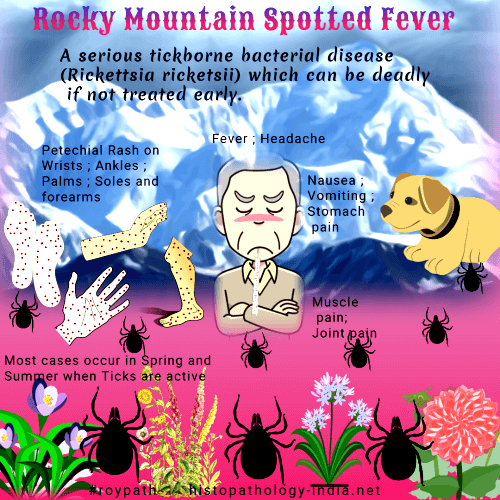
Clinical presentation:  After an incubation period of 2 to 12 days the patient develops severe headache, fever, and frequently nausea, vomiting, or abdominal pain.


A maculopapular rash appears on the wrists and ankles 2 to 5 days later, usually spreads to involve the trunk, palms, and may become petecheal. Delay or absence of rash and frequent lack of a history of tick bite make misdiagnosis and fatality a genuine problem.


In severe cases the patient may manifest signs of encephalitis, noncardiogenic pulmonary edema, skin necrosis, coagulopathy with bleeding, acute renal failure failure, jaundice, hypovolemic shock.


In fatal cases death usually ensues 8 to 15 days after onset of symptoms.


There is a fulminant form of RMSF observed most often in glucose-6-phosphate dehydrogenase deficient black males in which the patient may die before the fifth day of illness.


Early treatment with tetracycline or chloramphenicol cures most patients ; however, late diagnosis and inappropriate treatment result in an overall mortality of 3% to 8%.

Pathological presentation:  

Rickettsiae spread via the blood stream, enter endothelial cells, proliferate within the cytoplasm and nuclei of endothelial and vascular smooth muscle cells of the microcirculation of virtually all organs, and directly injure the foci of infected cells.

The consequence is systemic vascular damage that is the pathologic basis for the rash, interstitial pneumonia, interstitial myocarditis, meningoencephalitis, hepatic portal triaditis, and interstitial nephritis.

Microscopically the vasculitis consists of swollen or necrotic endothelial cells ; intramural and perivascular infiltration, predominantly by macrophages and T-lymphocytes with few polymorphonuclear   leukocytes ; focal extravasation of erythrocytes ; and occasionally, usually nonocclusive, eccentric thrombi in the foci of rickettsial infection. In the skin these foci are located principally in the dermis.

In the brain the lesions assume a characteristic appearance, so-called typhus nodules, found most frequently in the brain stem. These  perivascular accumulations of mononuclear cells, which measure 100 to 180 micrometer in diameter, indicate a probable rickettsial infection though they are not pathognomonic. Other neuropathologic lesions include microinfarcts of white matter and a mild mononuclear cell-rich leptomeningitis.

Lungs are congested and heavy. Microscopic pulmonary lesions include mononuclear interstitial pneumonia and interstitial and alveolar edema and hemorrhages.

The heart is grossly normal except for epicardial petechiae, but it usually manifests a mild mononuclear interstitial myocarditis on microscopic examination.

The hepatic portal triaditis and multifocal perivascular interstitial nephritis correspond to foci of infection of hepatic portal blood vessels and the renal microcirculation near the corticomedullary junction, respectively. Erythrophagocytosis occurs in Kupffer cells and macrophages within sinus of lymph nodes.

In fulminant RMSP there are more thrombi and fewer intramural and perivascular leukocytes in foci of vascular injury. 

Disseminated vascular foci of rickettsial infection and microvascular injury result in leakage of intravascular fluid into the interstitial space with consequent edema and hypovoluemia.

Consumption of platelets and coagulation factors in thrombi at the sites of injury can cause thrombocytopenia and in very severe cases more severe coagulopathy.

Focal lesions in the skin are the cause of rash. Vasodilatation and petechiae are the basis of the cutaneous erythematous macules and central “spots” respectively.    Image Link

Increased vascular permeability of the infected pulmonary microcirculation may result in noncardiogenic pulmonary edema. Myocardial injury is not a significant factor.

Central nervous system lesions are the cause of coma, seizures, multifocal, neurologic signs, and probably cardiorespiratory arrest.

Jaundice correlates with hemolysis and portal triadal inflammation.

Acute renal failure results from hypovolemic prerenal azotemia or, in more severe cases, acute tubular necrosis.

Vasculitis in the gastrointestinal tract is the apparent pathologic basis for nausea, vomiting, and abdominal pain and tenderness.

Pathogenesis:   Thrombosis and activation of the kallikrein-kinin pathways may exacerbate the disease and the acute-phase response presumably mediated by interleukin-1 is observed.  R. rickettsii does not seem to produce a toxin. Direct injury of infected cells by rickettsiae has been documented. The pathogenic mechanisms of the host cell injury have not been elucidated though cell membrane injury by phospholipase A and protease enzymes has been proposed. 


Abstracts:

Rocky Mountain spotted fever in an American tourist.Ned Tijdschr Geneeskd. 2005 Apr 2;149(14):769-72

Rocky Mountain spotted fever from an unexpected tick vector in Arizona.N Engl J Med. 2005 Aug 11;353(6):587-94

Rocky Mountain Spotted Fever as a cause of macular star figure.
J Neuroophthalmol. 2003 Dec;23(4):276-8

Cutaneous histopathology of Rocky Mountain spotted fever.J Cutan Pathol. 1997 Nov;24(10):604-10

Rocky mountain spotted fever: hepatic lesions in childhood cases.Pediatr Pathol. 1986;5(3-4):379-88

Spotted fever group rickettsiae in immature and adult ticks (Acari: Ixodidae) from a focus of Rocky Mountain spotted fever in Connecticut.Can J Microbiol. 1985 Dec;31(12):1131-5

Pulmonary pathology of Rocky Mountain spotted fever (RMSF) in children.Pediatr Pathol. 1985;4(1-2):47-57.

Rocky Mountain spotted fever: a warm weather problem.Nurse Pract. 1984 Aug;9(8):24-8

Rocky Mountain spotted fever. Gastrointestinal and pancreatic lesions and rickettsial infection.Arch Pathol Lab Med. 1984 Dec;108(12):963-7

The liver in Rocky Mountain spotted fever. Am J Clin Pathol. 1981 Feb;75 (2):156-61

 
Web www.histopathology-india.net
June 2007

Surgical-Pathology.com

Histopathology-India.net

Eye Pathology Online

Cardiac Path Online;

Pulmonary Pathology Online

Pathology Quiz Online;

Dermpath-India;

GI Path Online

Mesothelioma-Online;

Soft Tissue Pathology;

Case Index

Infectious Disease Online; INDEX: A-D ; INDEX: E-L ; INDEX: M-P INDEX: Q-Z ; FUNGAL DISEASE ; VIRAL DISEASE.

Acrodermatitis chronica atrophicans

Actinomycosis

Adenovirus

African Histoplasmosis (Histoplasma Duboisii)

AIDS:  Cutaneous lesion associated with AIDS

AIDS related malignant tumours

African Trypanosomiasis

Ascariasis

Aspergillosis

Atypical Mycobacterial Infection

Bacillary angiomatosis

Blastomycosis

Bronchopneumonia

Candidosis

Chagas' Disease

Chikungunya

Coccidioidomycosis

Cryptococcosis

Cryptosporidium

Cytomegalovirus infection

Dematiaceous fungal infection

Dengue

Dermatophytosis

Giardiasis

Human Papilloma Virus Associated Epidermal Lesions

Infective Endocarditis

Leishmaniasis 

Malaria

Meningococcal Infection

Measles

Molluscum Contagiosum

Mycobacterium Avium Intracellulare

Onchocerciasis

Pneumocystis Pneumonia

Protothecosis

Pseudomembranous Colitis (Clostridium difficile)

Psittacosis (Ornithosis, Parrot Fever)

Pulmonary Infection

Rat Bite Fever

Rhinosporidiosis

Schistosomiasis

Shigellosis

Skin infections- (Histo-pathological patterns)

Sleeping Sickness

Subacute Sclerosing Panencephalitis