Custom Search
|


|
Infectious Disease Online Pathology of Trichuriasis
|
| Syn
: Trichuris trichiura infection ; Whipworm infection ;
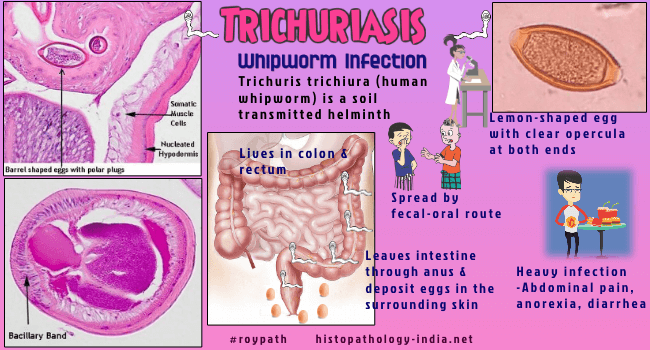
Trichocephaliasis. Trichuris trichiura (whipworm) is one of the most common intestinal parasites of humans in tropical areas. An estimated 1049 million persons harbour Trichuris trichiura, including 114 million preschool-age children and 233 million school-age children. The prevalence of Trichuris trichiura is high and may reach 95% in children in many parts of the world where protein energy malnutrition and anaemias are also prevalent and access to medical care and educational opportunities is often limited. Mode of infection: Trichuriasis is contracted through the ingestion of food or water containing the ova. Life cycle: The larvae are released from the embryonated ova into the small intestine and become attached to the mucosa. Subsequently, they migrate downward to their usual habitat in the ileocaecal region. The anterior tip of the whipworm rarely penetrates below the muscularis mucosae, thus eliciting practically no reaction on the part of the tissues. Clinical presentation: In case of massive infection with T. trichiura , prominent hyperemia and edema of the mucosa with occasional ulcerations may be produced, but in the majority of cases the infection does not produce symptoms. In severe cases blood-streaked stools are observed. In the most severe cases rectal prolapse may occur. Colonic obstruction because of a tangle of worms, and perforation have been reported. The blood loss that can occur in Trichuris trichiura infection is likely to contribute to anaemia, particularly if the child also harbours hookworm, malaria and/or has a low intake of dietary iron. Undernutrition and intestinal parasitic infections affect childhood development and morbidity in many developing countries. Undernutrition may increase susceptibility to parasitic infections which in turn impair the nutritional status of the host. Rapid, severe dehydration and concominant electrolyte imbalance may cause death. Diagnosis of the disease: Peripheral eosinophilia is practically never seen in pure Trichuris infection. Diagnosis is made when the characteristic ova are found on stool examination. Colonoscopic study should be considered a useful tool for the diagnosis of Trichuris trichiura infection, even if no ovum is found in stool examination. Trichuris trichiura infection can mimic other forms of inflammatory bowel disease and lead to physical growth retardation and prolonged regimens of albendazole may be required for the effective treatment of massive infestations. Community control is important, particularly for the individuals within a population who harbour heavy worm burdens; this means children, with special attention to girls who will experience increased iron requirements and blood loss due to menstruation, pregnancies, and lactation. Mebendazole and albendazole, both of which are on the WHO Essential Drugs List, are very effective against Trichuris trichiura ; multiple doses are needed to attain complete parasitological cure in all cases. However the goal of control programmes in endemic areas is morbidity reduction, which follows when intensity of infection is significantly reduced. |
Further reading: Massive Trichuris trichiura infection as a cause of chronic bloody diarrhea in a child. |
|
|