

Custom Search
|



|
Infectious Disease Online Pathology of Trichinellosis (Trichinosis)
|
|
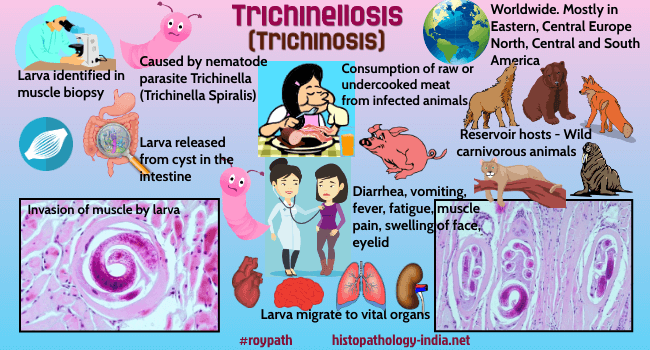
Trichinellosis, or trichinosis, is a parasitic zoonosis caused by nematodes of the genus Trichinella. The parasite infects domestic and wild animals and has a worldwide distribution. Humans become infected when they eat raw or undercooked meat (pigs or wild game) containing Trichinella larvae. |
|
Syn:
Trichinellosis ; Trichiniasis Trichinosis, an infection by the nematode Trichinella spiralis, is most common in eastern and central Europe, North America, Central, South America and Asia. Although it prevails in areas where pork is eaten, many animals,including dogs, cats, rats, bears, foxes, and wolves, are reservoirs of infection. Humans become infected by eating undercooked or raw meat containing encysted larvae, mainly pork. The cysts located in striated muscle,are digested, liberating larvae that mature to adult worms that attach to the wall of the small intestine. Female worms there liberate larvae that invade the intestinal wall, enter the circulation, and penetrate striated muscle, where they encyst and remain viable for years. The clinical features are highly variable, depending on the number of larvae ingested, and patients may be asymtomatic or die of a fulminating disease. In subclinical disease the only sign is eosinophilia. The invasion of muscle by the larvae is associated with muscle pain, swelling of the eyelids and facial edema, eosinophilia, and pronounced fever. Respiratory and neurologic manifestatations may appear. Fatal cases are usually attributed to a severe myocarditis. During the chronic phase of the disease the symptoms gradually attenuate. On invasion of the muscle the larvae cause inflammation and destruction of muscle fibres. A fibrous hyaline layer develops around a single coiled larva. Histiocytes and giant cells may surround the cyst, which eventually calcifies. The most frequently involved muscles are those of the limbs, diaphragm, tongue, jaw, larynx, ribs and eye. Larvae in other organs, including the heart and brain, cause edema, necrosis, and focal infiltration of neutrophils, eosinophils, and lymphocytes, but they do not encyst. The diagnosis is made by identifying larvae in muscle biopsies or by serologic tests. Antihelminthic drugs remove adult worms from the intestine. |
|
|


Copyright © 2022 histopathology-india.net