Custom Search
|



|
Infectious Disease Online Pathology of Blackwater Fever
|
|
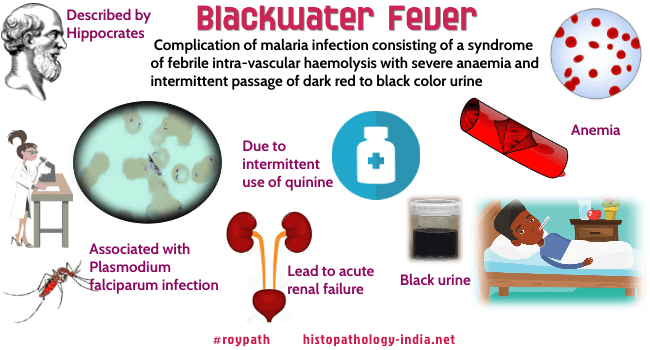
Blackwater fever or hemoglobinuric fever is a very dangerous complication of malignant malaria.This clinical syndrome of haemoglobinuria accompanied by fever was recorded in the time of Hippocrates, its strong association with malaria was not recognized until the 19th century. It was described by an English surgeon named Tidlie (1819) in West Africa. Visit related post: Malaria This clinical entity is characterized by acute intravascular hemolysis classically occuring after the re-introduction of quinine in long-term residents in Plasmodium falciparum endemic areas and repeatedly using the product. This condition is also common in patients who have been subject to excessive fatigue, exhaustion, shock or injury,intercurrent infection, childbirth or alcoholic excess. Clinical presentation: Within a few days of onset there are chills, with rigor, high fever, jaundice, vomiting, rapidly progressive anemia and the passage of dark red or black urine. The cause of hemolytic crises in this disease is unknown. There is rapid and massive destruction of red blood cells with the production of hemoglobinemia, hemoglobunuria, intense jaundice, anuria, and finally death in the majority of cases. The most probable explanation for blackwater fever is an autoimmune reaction. Pathology: Macroscopically and microscopically the kidneys show features similar to those of hemoglobinuric or tubular nephrosis. The severity of the clinical picture often requires initial management in intensive care unit. Nowadays, however, prognosis is good and the disease usually regresses without after effects.
|
|
Further reading: Blackwater fever: the rise and fall of an exotic disease.J Nephrol. 2009 Nov-Dec;22 Suppl 14:120-8. Haemolytic crisis of blackwater fever following artemether-lumefantrine intake. Blackwater fever in children, Burundi. Epidemiological and clinical aspects of blackwater fever among African children suffering frequent malaria attacks. Blackwater fever in adults with sickle cell anemia. Two fatal cases. Recurrence of blackwater fever: triggering of relapses by different antimalarials. Blackwater fever in southern Vietnam: a prospective descriptive study of 50 cases.
|
|
|