Custom Search
|



|
Dermpath-India Pathology of Sebaceous Hyperplasia Dr Sampurna Roy MD 2022
|
|
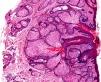
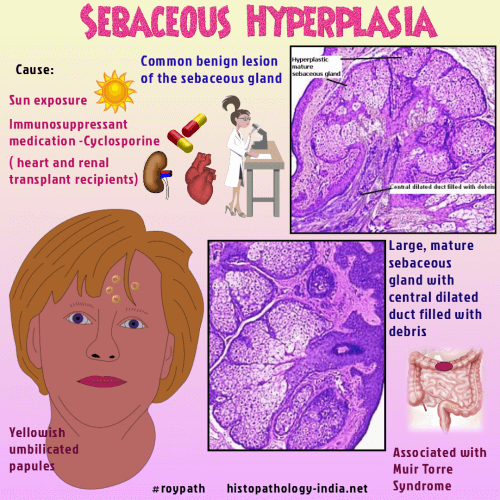
Sebaceous hyperplasia is a common benign lesion of the sebaceous gland.
This lesion has been seen in heart transplant and bone marrow recipients and is probably due to the effects of Cyclosporine.
Clinical presentation: Usually occurs in middle aged patients, but cases have been reported in younger individuals. Juxtaclavicular beaded line - variant of sebaceous hyperplasia characterized by papules arranged in parallel rows resembling 'strands of beads'. Site: Face, forehead, chest, areola, mouth, vulva etc.
Differential diagnosis: Nevus sebaceus (lobules are aberrant, ducts open into the epidermis, there is epidermal hyperplasia and in some cases apocrine glands) Rhinophyma (sebaceous glands are not as well defined and grouped as in sebaceous hyperplasia).
|
|
|