Custom Search
|



|
Infectious Disease Online Pathology of Bolivian Hemorrhagic Fever |
|
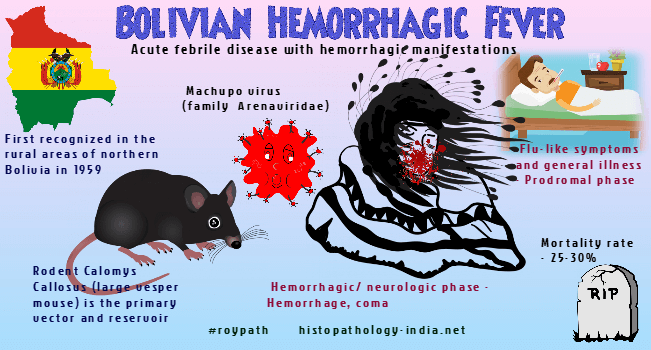
Bolivian hemorrhagic fever is an acute febrile disease with hemorrhagic manifestations that are almost identical to those of Argentine hemorrhagic fever. It is a disease endemic to northeastern Bolivia. Mortality rate of this disease is 25 to 35%. The etiological agent is Machupo virus (MACV, family Arenaviridae). Related posts Lassa Fever The virus is similar to that which causes Argentine hemorrhagic fever, and its reservoir is also wild rodents. Bolivian hemorrhagic fever was first recognized in rural areas of northern Bolivia (1959), and there were two major epidemics in Bolivian villages during 1962-64. The rodent Calomys callosus was identified as the primary vector and reservoir for the virus. Human disease is biphasic with symptoms first identified in the prodromal phase which include general illness and flu-like symptoms. One third of patients enter a hemorrhagic/neurologic phase where the most severe symptoms are identified including hemorrhage and coma. Survivors enter a convalescent stage, which can last weeks to months.
|
|
|