Custom Search
|
|
Custom Search
|
|
Dermpath-India Pathology of Hidradenoma Papilliferum (Papillary Hidradenoma) Dr Sampurna Roy MD 2022
|
 |
|
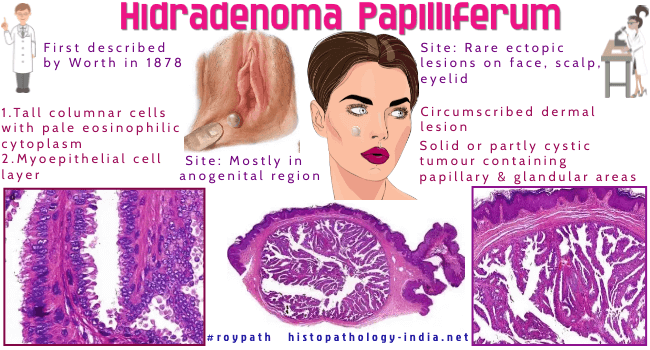
Hidradenoma papilliferum
(papillary hidradenoma) is a
benign tumour and was previously regarded as an apocrine tumour.
Hidradenoma papilliferum was first
described by Worth in 1878. Cooper and Mac Donald, in 1944, described the first case of perianal hidradenoma papilliferum. According to some authors this tumour is a variant of apocrine adenoma with specific features. Now there is increasing evidence to suggest that it is closely related to the recently described mammary-like anogenital glands. Site: Almost always located in the vulval or perianal reginions. Ectopic lesions have been reported on the face, scalp, eyelid, auditory canal and arm. Clinical presentation: The tumour usually occurs in middle aged women as small nodules (1cm or less in size).
Differential Diagnosis: The differential diagnosis includes adenocarcinoma.
|
|
|
|
|
Visit:- Infectious Disease Online
Visit :- Papillary Eccrine Adenoma, Syringocystadenoma Papilliferum ;

Copyright © 2002-2022 histopathology-india.net