Custom Search
|



|
Dermpath-India Pathology of Lipoleiomyoma Dr Sampurna Roy MD 2022
|

 |
|
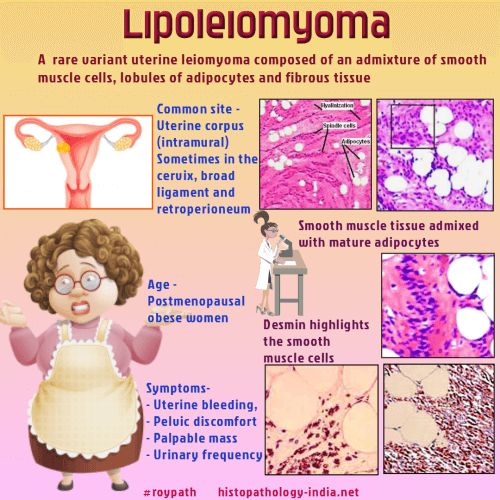
Lipoleiomyomas of the uterus are extremely rare tumour and occur in different locations including cervix. These are characterized by scattered islands of mature fat cells which may represent "lipomatous" metaplasia of a pre-existing leiomyoma. Lipoleiomyomas generally occur in obese perimenopausal or postmenopausal women and the patients often have a high incidence of gallbladder disease. Uterine lipoleiomyomas are often diagnosed preoperatively as uterine myomas or ovarian mature teratomas. The key to distinguishing the tumors from lipoleiomyomas is to ascertain the primary site of development - uterus or adnexa. When a large uterine tumour is found in a postmenopausal woman, the possibility of malignancy should be considered.
Piloleiomyoma ; Angioleiomyoma ; Genital Leiomyoma
|
|
Further reading Blaustein’s Pathology the Female Genital Tract. 5th Edition New York: Springer,2002. Uterine bizarre lipoleiomyomaLipomatous lesions of the uterus. Lipoleiomyomatous tumours of uterus: a heterogeneous group? Histopathological study of five cases. Atypical lipoleiomyoma of the uterus. Benign "metastasizing" lipoleiomyoma of the uterus
|
|
|
|
|