Custom Search
|



|
Infectious Disease Online Pathology of Bacillary Angiomatosis Dr Sampurna Roy MD 2023
|
 |
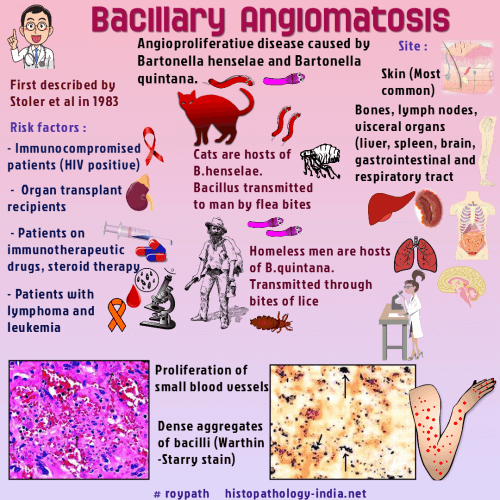
| Bacillary angiomatosis, first described by Stoler et al.in 1983, is a vasoproliferative, pseudoneoplastic lesion caused by small, gram-negative bacilli Bartonella henselae and Bartonella quintana. In this infectious disease there is proliferation of small blood vessels in the skin and visceral organs of patients with human immunodeficiency virus infection and other immunocompromised hosts. |
|
The condition now known as
Bacillary angiomatosis was first described by Stoler et al. in 1983. An
atypical subcutaneous infection associated with acquired immune deficiency
syndrome.
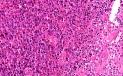
Visit: Bartonellosis ; cat-scratch disease ; verruga peruana . Bacillary angiomatosis is an infectious disease causing proliferation of small blood vessels in the skin and visceral organs of patients with human immunodeficiency virus infection and other immunocompromised hosts. Cases have been reported in organ transplant recipients, in patients with leukemia and those on systemic steroid therapy. This vasoproliferative, pseudoneoplastic lesion is caused by small, gram-negative bacilli Bartonella henselae and Bartonella quintana. The organisms are often visualized in tissue sections of lesions with Warthin-Starry staining. Bartonella henselae is also a common cause of cat-scratch disease. Site: Cutaneous bacillary angiomatosis is the most common clinical form of bacillary angiomatosis. Skin lesions present as multiple red papules, subcutaneous nodules, or cellulitic plaques. Bacillary angiomatosis can also present in a wide variety of sites such as the lymph nodes, liver (bacillary peliosis hepatis), spleen, soft tissues, bone, heart, central nervous system, oropharynx, larynx, endobronchus, duodenum, and blood. Microscopic feature: Image1 ; Image2 Bacillary angiomatosis is characterized histologically by proliferation of small rounded blood vessels lined by plump (epithelioid or histiocytoid) endothelial cells, in an edematous stroma. A backround inflammatory cell infiltrate of lymphocytes, histiocytes and neutrophils is also present. A heavy infiltrate of neutrophils is frequently present in deeper lesions. Organisms are seen as clumps of amphophilic granular material particularly near neutrophils. These are dense aggregates of bacilli. They are readily demonstrated by a Warthin-Starry or Grocott-methenamine silver stain. In the liver and spleen, there may be features of peliosis. Immunohistochemical techniques and PCR-based methods have also been used to identify organisms. Differential diagnosis: This condition needs to be distinguished from a variety of reactive and neoplastic vascular proliferations. Kaposi's Sarcoma: The main differential diagnosis to consider is Kaposi's sarcoma, which morphologically may resemble bacillary angiomatosis and also occurs in immunocompromised individuals, especially human immunodeficiency virus–positive persons. The vessels in Kaposi's sarcoma are cleft-like, the endothelial cells are spindled shaped, and there are no aggregates of bacteria present. Bacillary angiomatosis is characterized epithelioid endothelial cells, neutrophils, and organisms. Pyogenic granuloma: Neutrophils are confined to the surface of the ulcerated lesions. Organisms are not present. The lesions are more obviously lobulated. Verruga Peruana: Vascular proliferative lesions caused by Bartonella bacilliformis. Rocha Lima inclusions must be identified to establish the diagnosis. Bacillay angiomatosis is potentially lethal but shows an excellent response to antibiotics such as erythromycin. The incidence has decreased with the introduction of prophylactic antimycobacterial therapy.
|
|
|
|
|