Custom Search
|



|
Dermpath-India Pathology of Folliculosebaceous Cystic Hamartoma Dr Sampurna Roy MD 2022
|
|
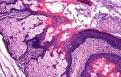
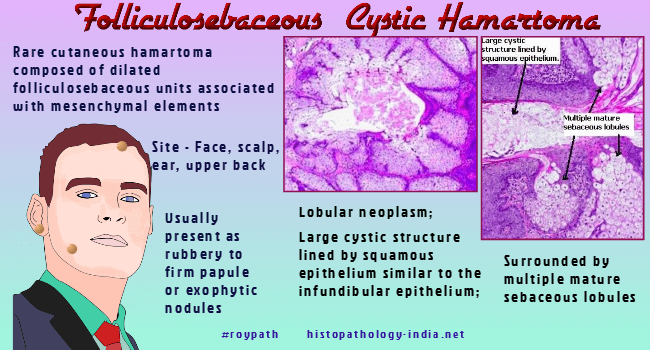
Folliculosebaceous cystic hamartoma (FSCH), first described by Kimura et al in 1991, is a rare cutaneous hamartoma composed of dilated folliculosebaceous units associated with mesenchymal elements. Some authors have presented evidence suggesting that this lesion is very closely related to trichofolliculoma. Clinical presentation: Majority of lesions present as 0.5-1.5 cm papules or exophytic nodules. Lesions are usually rubbery to firm in consistency. Typically arise in adulthood but the giant variant appears to be congenital and enlarges during puberty. Site: Face or scalp, ear and upper back.
Differential diagnosis: - Sebaceous gland hyperplasia ; - Steatocystoma ; - Nevus sebaceus of Jadassohn ; - Small aberrant sebaceous glands, - Budding in close association with a hyperplastic papillomatous epidermis. - Sebaceous trichofolliculoma - Histopathologically , FSCH shares several similar features to sebaceous trichofolliculoma, but it is usually possible to differentiate these two tumours ; - Dermoid cyst of skin.
|
|
|
 |