Custom Search
|



|
Dermpath-India Pathology of Tubular Apocrine Adenoma Dr Sampurna Roy MD 2022
|

|
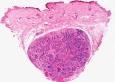
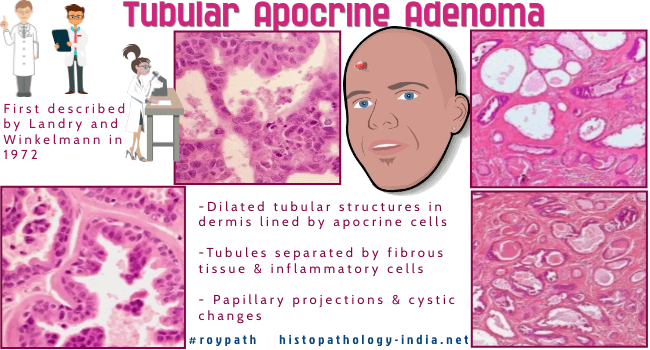
Apocrine adenomas are rare adnexal tumours. Tubular apocrine adenoma (tubulopapillary hidradenoma with apocrine differentiation) was first described by Landry and Winkelmann in 1972. Related post : Papillary Eccrine Adenoma Tubular apocrine adenomas show some features of syringocystadenoma papilliferum .Some cases have been associated with naevus sebaceous. Clinical presentation: Slow growing circumscribed nodule. Site: Apocrine adenomas have been reported in the axilla, cheek and breast. Cases reported in vulval and perianal region are now known as 'adenomas of anogenital mammary-like glands'. Tubular apocrine adenomas are often located on the scalp.
Differential diagnosis: Syringocystadenoma Papilliferum ; Apocrine adenocarcinoma; Dermatopathology Quiz Case: 129
|
|
|